Showing posts with label Adapting original art to needlepoint. Show all posts

Sunday, May 24, 2009

Putting the pillow to bed

Today I finally finished my Kyrgyz pillow, an adaptation of a motif from a fragment of a tush kyiz or ceremonial bed hanging. The original was embroidered by an incredibly patient person in Kyrgyzstan in Siberia.

The seven-foot-long fragment was embroidered with cotton thread on cotton material indigenous to the area. My adaptation was stitched in basketweave using Silk & Ivory thread on 13-count canvas. I've tried to duplicate the original colors as closely as possible, and the size of my canvas is exactly the same as the original motif.

Friday, April 24, 2009

More pillow talk


In between projects, I had a little time to stitch on the Kyrgz pillow design. Now a little more than half done, I've actually finished with one of the colors of Silk & Ivory -"Taupe." And with the addition of the "Peanut Butter" in the top left motif, all of the colors which will appear in the pillow have been introduced.

While I go back and resume stitching in "basic black," do go visit Sue Dulle's blog (www.sudukc.wordpress.com) to see her wonderful finish of my Thomas Jefferson cylindrical ornament. "TJ" is a real cutie, from the top of his tricorn hat to the tip of his patent leather shoes.

Saturday, March 21, 2009

Bringing new meaning to color


A little more than one-quarter of the Kyrgyz pillow is now stitched. I've been a good girl and have kept up with the background stitching so far! Except for the golden brown, all of the colors I'll be using appear in this progress photo.

The more I've stitched, the more I've been wondering why the Kyrgyzstani woman who embroidered the original tush kyiz chose the colors she did. Her threads were undoubtedly hand-dyed using vegetable dyes. But did she use specific colors to convey special meaning to this wall hanging for a marital bed?

After doing a little research on the symbolism of color in Asian cultures, here's what I found out about the meaning of the colors I'm using:

Red: Happiness, marriage and prosperity
Pink: Marriage
Blue: Self-cultivation and wealth
Green: Eternity, family, harmony, health, peace and prosperity
Gold: Strength and wealth
Brown: Earth, hearth, home and endurance
Black: In its positive connotions, career, knowledge and formality

So in essence, the mother of the bride or groom who created the original hanging was conveying any number of good wishes to the newly-wed couple through her colorful stitching. Considering that the almost 7-foot fragment from which I adapted my project is part of a much larger piece of embroidery, I can only hope for the stitcher's sake that the Kyrgyzs believed in long engagements!

Saturday, March 14, 2009

A lot of black, a little color


I've started stitching the first quadrant of the Kyrgyz pillow and am happy so far with my progress. There's a LOT of black background in this piece, so I've tried to discipline myself to stay "one step ahead of the shoeshine, two steps ahead of the county line" in stitching the background before interjecting a bit of color.

The canvas is mounted on 18-inch-square stretcher bars, and reaching the top really IS a stretch but doable. I'll rest my weary arm by heading down to the lower section of the quadrant, where soon I'll hit another patch of color!

Thursday, March 12, 2009

Ready to stitch!


I've finished transferring the design elements to my 13-count canvas as a line drawing, and now I'm ready to stitch! The colors of Silk & Ivory I'll be using, besides the black for the background, are:

#29 - Guacamole (green)
#67 - Peanut Butter (golden brown)
#161 - Lida Rose (pink)
#110 - Blueberry (Wedgwood blue)
#15 - Honey (golden tan)
#68 - Cayenne (rust red)
#08 - Taupe (light tan)
#64 - Curry (gold)

These threads should provide a nice splash of color against the black background.

Tuesday, March 10, 2009

Measure once, count twice


The first step in adapting the Kyrgyz tush kyiz fragment to a needlepoint pillow was to measure the three major design elements: the central medallion, the smaller medallions in the four corners, and the "tulips" at the top, bottom and sides. My goal is to reproduce this design in the exact size as the original.

I raided my stash for suitable threads and found that Silk & Ivory was the only one having all the colors most closely matching the original textile. And since I'm going to stitch the pillow entirely in basketweave, 13-count canvas was called for. So I multiplied the dimensions of the three elements by 13 in preparation for working them on graph paper.

The central medallion and smaller medallions (bottom photos) were relatively easy to figure out, because each has center lines from which to plot the diagonal lines radiating out. Each square on the graph paper represents an intersection on the canvas. I counted and recounted to be sure each section of these elements was the mirror image of the one across from it.

The "tulip" motif wasn't that easy. I made a copy of the photo and traced the tulip design, then manipulated the size on the computer (top right). With the tulip now the exact size, I traced it onto graph paper, making sure my tracing lined up exactly with the lines on the graph paper. I then marked each square so one side would mirror the other and all stitches would fall on an intersection of the canvas, not in a gulley (top left). If you have determined that you're "on target" at this stage, stitching the canvas later will be a breeze!

The next step will be to transfer my graph paper charts as a line drawing to the canvas itself. I'm the type of stitcher who likes to see everything in front of me on the canvas before I pick up my needle!

Sunday, March 8, 2009

Exploring a distant land


Thanks to a dear friend here on the Cape, I have a new project in which to immerse myself--once again adapting an original work of art to needlepoint. For this, a little background is definitely in order!

Kyrgystan is a country in central Asia. an entirely mountainous land slightly smaller than the state of South Dakota, with a population today of a little over 5 million people. But the first written record of the Kyrgyz tribe, nomads of central Siberia, appeared among the Chinese in 2000 BC. The tribe's history has been tumultuous, highlighted by a takeover by the Mongols--Genghis Khan's son--in the 13th century, and its annexation by the Russian Empire in 1876. It regained its independence from the USSR in 1991.

Its history is also rich in its textiles, cotton being one of its significant industries. Long known for its exquisite embroidery, the Kyrgyztani are moving away from the traditional, more personal family heirlooms--less favored by today's generation--while still maintaining a trade in felt rugs to the general public.

Luckily, there are some who cherish these traditions, including Canadians from British Columbia who are retrieving and preserving non-commercial textiles from this area. The piece I am working from is a tush kyiz, a large, elaborately embroidered wall hanging. Made by older women to commemorate the marriage of a son or daughter, the tush kyiz hung over the marriage bed as a symbol of tribal tradition. Now out of favor with the younger generation, it is no longer being made. But this fragment -- almost seven feet along-- has been preserved and mounted--gifted to my friend and on loan to me for further study.

I'm hoping to adapt this amazing work of art to needlepoint as a pillow. I've measured the motifs, compared colors with the threads in my stash, and now have a bit of calculating to do. The motif I'm planning to adapt is at the center of the complete picture and at the right in the smaller picture. Wish me luck!

Saturday, December 20, 2008

Water under the bridge


The last few days I feel as though I've been stitching a sea of white! It's kind of ironic, since there are five inches of snow on the ground outside with more falling as I write. But the water under the bridge, DMC floss in basketweave, is completed under the bridge, enabling me to do some outlining in black and finishing the underside of the bridge's arch.

Also finished are the three sections of foliage stitched in Nobuko with white Trio and the white background of the bridge itself, done in basketweave using DMC perle cotton.

Next to be worked on, between baking batches of Christmas cookies, are the stones in the bridge and the black surface lines in the water.

Wednesday, December 3, 2008

From paper to canvas


When I get an idea for a needlepoint design, my usual modus operandi is to sit down with a pencil and 10-squares-to-the-inch graph paper. I measure, I count, and then I count again--heck, I'm a stitch painter. Only when every square is accounted for do I actually transfer the design to canvas, each square faithfully recreated on one canvas intersection.

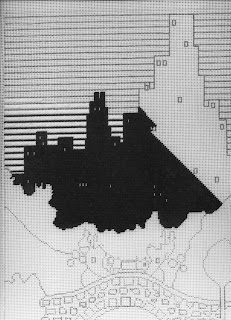
I quickly realized this tried-and-true method wouldn't work for my new project--my father's line drawing of Central Park. I'd need a piece of graph paper the size of Massachusetts--well, maybe Rhode Island? I happened to hold a piece of doodle canvas in front of the enlargement of the original art, and knew I had my solution--trace it! Being a black and white line drawing, the artwork showed beautifully through 18 ct. canvas.

The enlargement was 9-1/2 inches by 15 inches, so I cut a piece of blank canvas 14 inches by 20 inches. I then taped the enlargement to a piece of plywood larger than the canvas by several inches all around. I placed the canvas on top of the enlargement, lining up the outside edges so they corresponded to the vertical lines of the canvas, and taped down the canvas with masking tape. I figured--correctly--that it might take a couple of days to transfer the entire design, so I burnished the masking tape to the plywood by running the blunt end of a kitchen knife several times across the surface. I wasn't going to take the chance of the canvas shifting when I moved the plywood around.

I used the kitchen counter as my work table, since it's much higher than my work table and would keep me from having to lean over for long periods. Starting at the easiest section--the skyscrapers--I carefully traced the outline with a black Sharpie (yes, Virginia, it IS permanent). When I say "trace," I don't mean in the conventional way. More accurately, I "stitch-traced." When I got to a section which didn't exactly match up to a canvas intersection, I made the decision which intersection most closely followed the design and marked it. When I sit down to stitch a painted canvas, I want to enjoy myself, not have to make countless decisions about where one color ends and the next one begins. That's why I became a stitch painter in the first place.

The only parts of the design I didn't stitch-trace were the lines in the sky. I had already determined that they were three horizontal canvas lines apart, more or less, so I drew them in that way when I'd finished transferring the rest of the design.

My resulting canvas actually looks more like a line-drawn canvas than a painted canvas. But it is all black and white, and I made another executive decision: not to fill in the solid black areas and give my poor eyeballs a break. I already knew which thread I would be using for the skyscrapers and was completely confident that the thread would cover the white canvas completely.

As is probably true of a lot of stitchers, I was "hot to trot" to start stitching--and I did! I had my first thread already in my stash, and lost no time making a beginning on this canvas. Here's my progress to date!

Next up: how to change a two-dimensional drawing into 3-D needlepoint.

Monday, December 1, 2008

What was old is new again


First of all, many thanks to all of you who posted warm words of welcome! Frequent references to "taking the plunge" I find particularly amusing, since I'm already 35 miles out into the Atlantic Ocean, stitching with the fishes!

Now to put my newest project into perspective....

The year was 1927. Calvin Coolidge was president of the U.S. Prohibition had been in place for eight years. Charles Lindbergh made the first solo non-stop trans-Atlantic flight. Commercial trans-Atlantic telephone service began between New York and London. The movie "The Jazz Singer" opened, ending the era of silent films, and "Showboat" debuted on Broadway. Ford replaced the Model T with the Model A, which sold for $385. Work on Mt. Rushmore began, and Babe Ruth hit his 60th home run.

A 20-year-old senior at New York University was named art editor of the campus magazine "The Medley." His pen-and-ink drawing of Central Park in New York City, pictured here, was used in the November 1927 issue, illustrating a rather lame joke alluding to the difficulties in finding a beverage to quench one's thirst at that time.

Flash to 2008: I'd been looking for some artwork to jazz up our newly remodeled powder room, which has accents of black and white, and remembered this drawing. The only problem was the original artwork was way too small for my purposes--approximately 4-1/2 inches by 5-1/2 inches. The only way I could see of getting the image I wanted in the size I needed was to adapt the original to needlepoint.

I took the original drawing to Staples, where a helpful clerk enlarged the piece by 210 percent. Perfect! Now the artwork measured 9-1/2 inches by 15 inches, ideal for what I had in mind. And each copy only cost 20 cents--even better!

In my next post, I'll describe how I went about transferring the design to needlepoint canvas.

And for those of you ready to scream "Copyright Infringement!" at the top of your lungs, not to worry: the young illustrator of this piece was my father, and I'm his only child.